


Background & Challenge
Tracr creates a blockchain-based record for every natural diamond, allowing its journey from rough to polished to be fully traceable and verifiable. However, in China’s consumer market, traceability remained a highly abstract concept for most audiences.
While Chinese consumers care deeply about authenticity and trust, technical language such as “blockchain” or supply chain infrastructure rarely creates immediate engagement within WeChat’s fast-moving environment. Technical explanations alone were not enough to hold attention or encourage deeper exploration.
The challenge was not simply introducing traceability to consumers, but making it feel understandable, relevant, and worth engaging with inside a familiar digital ecosystem.

The Strategic Shift
Rather than leading with technical education, UMS reframed traceability as a consumer trust story.
Our approach focused less on explaining how the technology works, and more on why a diamond’s story matters to consumers. Instead of positioning provenance as a technical feature, we shifted the communication towards reassurance, transparency, and emotional relevance.
To support this, the campaign leveraged existing consumer-facing campaign assets to make provenance storytelling feel more approachable and engaging within WeChat.
This shift allowed us to build a more natural user journey inside the WeChat ecosystem — moving audiences from initial discovery into deeper exploration without creating friction or overwhelming them with technical information.
Solution
UMS used WeChat paid ads to amplify a consumer-oriented storytelling article designed to introduce Tracr and its Mini Program in a more accessible way.
Rather than pushing users directly into the Mini Program, the article acted as a softer entry point. Users first engaged with provenance storytelling in a familiar content format before choosing to explore further on their own.
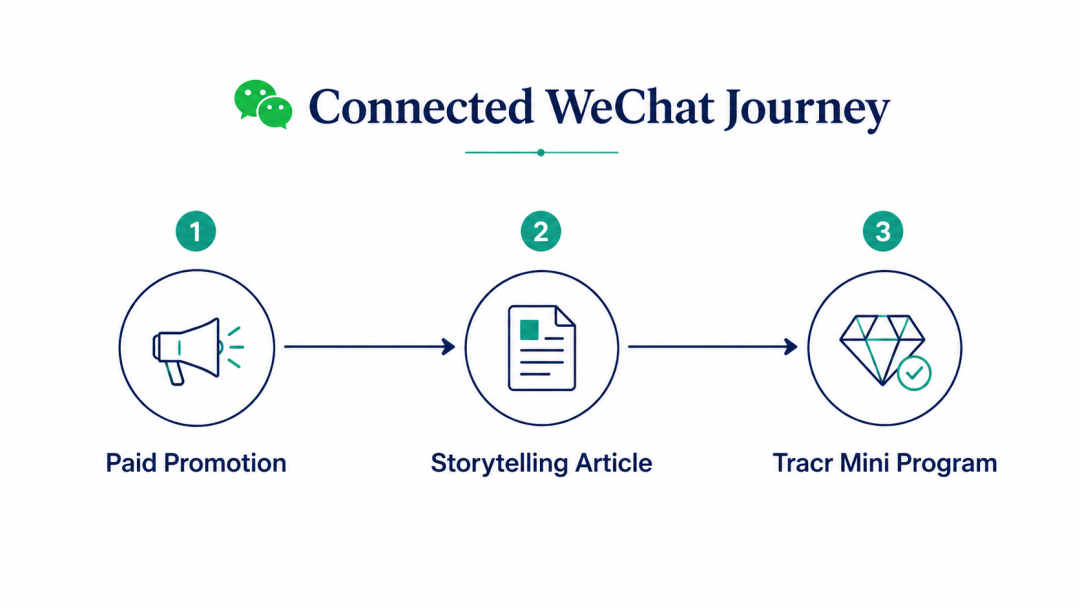
This closed-loop structure allowed paid media to support education and discovery simultaneously, guiding users from awareness into active exploration within a single ecosystem.
Results & Behavioural Impact
The campaign achieved strong visibility and sustained engagement across the WeChat ecosystem.
More importantly, users did not simply click through advertisements — many actively spent time engaging with provenance-related storytelling content before continuing into Tracr’s Mini Program for further self-directed exploration.
This progression from discovery to content engagement, to voluntary deeper interaction demonstrated that the campaign successfully transformed a highly technical concept into an experience consumers were willing to explore organically.
Rather than relying on aggressive calls-to-action, the campaign encouraged audiences to move naturally through the journey at their own pace, creating stronger engagement quality and deeper curiosity around traceability.

Insights
This project reinforced several important viewpoints about communicating complex value propositions in China:
- Technical concepts require behavioural localisation. Direct translation is rarely enough. Complex technologies become significantly more effective when reframed through consumer behaviour, emotional relevance, and platform-native storytelling.
- Integrated ecosystem journeys create stronger engagement. Paid media, content, and Mini Program experiences are most effective when designed as one connected journey rather than isolated touchpoints.
- Paid amplification works more effectively alongside strong storytelling. Paid media alone does not create engagement. Its real value comes from amplifying content that already feels relevant, approachable, and worth exploring.
Ultimately, Chinese consumers did not engage because of the blockchain itself. They engaged because the experience felt understandable, relevant, and easy to explore within a familiar platform.
This is what we helped Tracr achieve.
For more information on how UMS can support your brand’s marketing and consumer engagement in China, please contact our team at sales@umssocial.com.