


For many overseas universities, China has long been understood as a major source market for international students. The traditional logic was familiar: Chinese families valued overseas education, international degrees carried prestige, and studying abroad was seen as a pathway to stronger career and life opportunities.
That logic has not disappeared. But it is becoming more complicated.
The QS World University Rankings 2027 show why the competitive landscape is changing. Out of 1,504 ranked institutions globally, the greater China region accounts for 126 ranked universities, including 85 from Mainland China, 10 from Hong Kong SAR, 4 from Macao SAR and 27 from Taiwan. Among the 85 Mainland Chinese institutions ranked, Peking University places 13th globally, followed by Tsinghua University at 14th, Fudan University at 26th, Shanghai Jiao Tong University at 36th and Zhejiang University at 47th.
Mainland China alone added 13 new entrants this year, making it the third-largest higher education system represented in the ranking after the United States and the United Kingdom.
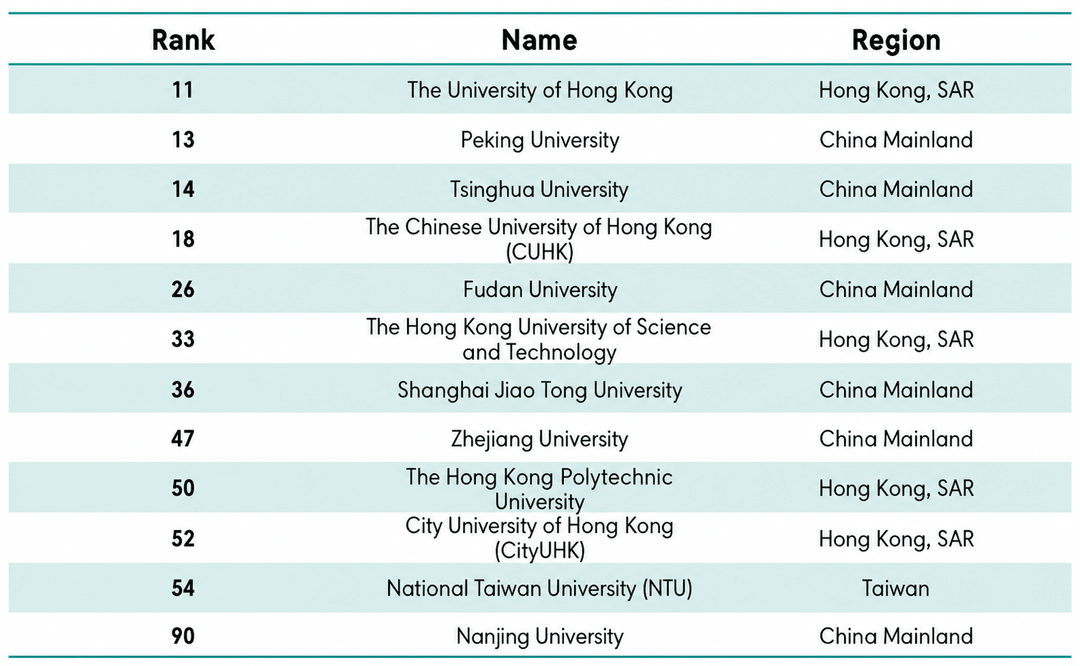
For overseas universities seeking to recruit Chinese students, this marks an important shift. They are no longer competing only against other international institutions; they are also competing against a broader and increasingly visible Chinese higher education ecosystem. To stay competitive, universities outside China must prove the additional value they can offer compared with staying at home: stronger subject expertise, better career pathways, more international exposure, clearer employer recognition, or outcomes that students and families see as worth the additional cost, time and risk.
This changes the recruitment question. It is no longer enough to say: “Study overseas because it is international.” Families are asking: “Why this institution, why this country, why this degree, and why is it worth the cost compared with what is available in China?”
For top global universities, the answer may still be relatively clear. For overseas institutions with weaker visibility in China, the answer is much harder.
Of course, the rise of Chinese universities does not mean that all families will choose to stay closer to home. For certain student segments—particularly those seeking specialised international careers, advanced research exposure, global professional networks or deeper cultural immersion—overseas education may remain difficult to replace.
The question is therefore not whether Chinese students will continue to study abroad, but which students will find which overseas pathways genuinely valuable.
The Competition Has Always Been About Rank, Status and Return on Investment.
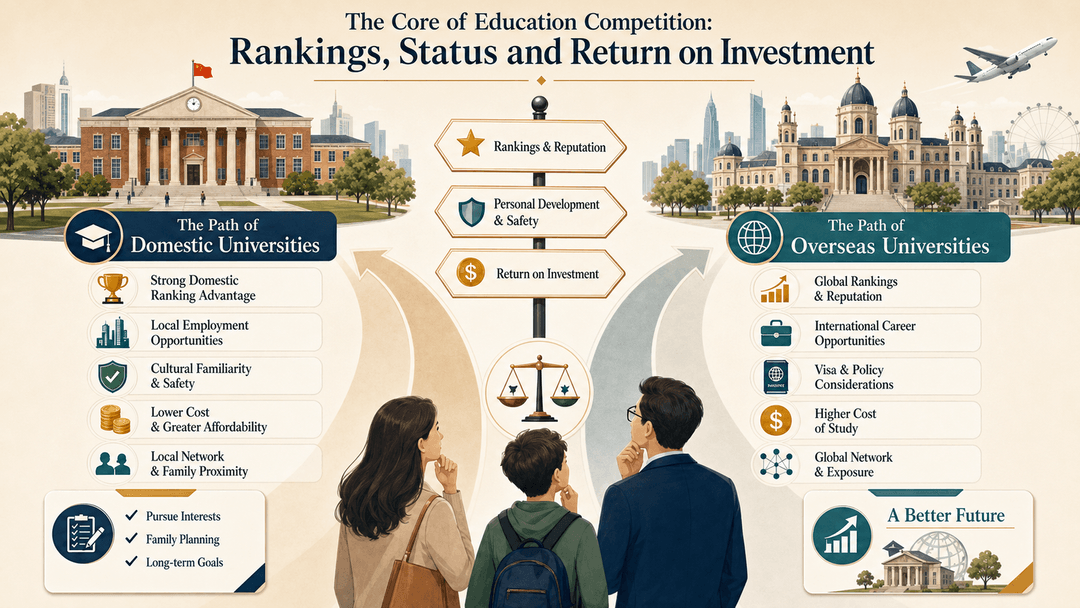
The rise of Chinese universities in global rankings may be relatively recent, but the competitive logic shaping education decisions is not. In China, a university offer is rarely viewed as the student’s choice alone. It is often a household decision, shaped by parents, grandparents and wider family expectations.
Alongside rankings and career outcomes, families are also weighing geopolitical tensions, visa policy changes, rising living costs, public safety and the economic outlook of host countries. These factors increase the perceived cost and risk of overseas study, making the additional value of an international pathway more important to demonstrate.
Chinese families have long made education decisions through a broader framework of hierarchy, institutional prestige and return on investment. The pursuit of 985, 211 and Double First-Class universities in China***, alongside highly ranked overseas institutions and globally recognised qualifications, reflects the same underlying system of competition.
Within this system, education is rarely viewed as an individual experience alone. It is closely connected with social mobility, family aspiration, long-term security and status. A university name can influence employment opportunities, access to professional networks, opportunities in top-tier cities, family pride and the student’s perceived future trajectory.
The return on investment of an overseas qualification is therefore understood more broadly than graduate salary. For many families, it may include stronger job security, improved social positioning, access to major cities, larger professional networks, greater income potential and a more stable long-term life path. In some cases, it may also influence wider perceptions of personal and family status, including expectations in the marriage market.
The fundamental question has therefore remained consistent: which education pathway gives the child the strongest chance of achieving a better future?
What has changed is the competitive position of Chinese universities. As more Chinese institutions strengthen their standing in both domestic and global rankings, the same ranking logic that once encouraged families to look overseas is now making high-quality domestic pathways more attractive.
*A short explanation of these classifications is included at the end of this article.
Families Are Comparing Pathways, Not Countries
Chinese families are not simply choosing between studying in China and studying overseas. They are comparing different education pathways.
One route may be the domestic gaokao pathway into a 985, 211 or Double First-Class university. Others may include an international curriculum through A-Level, IB or AP, a transnational education programme, a full undergraduate degree overseas, or a Chinese undergraduate degree followed by postgraduate study abroad.
Overseas universities are therefore competing not only with individual institutions, but with complete education strategies designed around cost, time, risk and long-term outcomes.
These decisions often begin long before the university application stage. For many families, particularly in larger cities, pathway-defining choices may already be taking shape by the end of primary school or during junior secondary school: public or international education, gaokao or an overseas curriculum, domestic undergraduate study or preparation for an international pathway.
Time and efficiency matter. Families are often trying to build a coherent, long-term pathway that gives the student a realistic advantage in education, employment and life, while avoiding unnecessary changes of direction, additional costs or lost time.
This is why overseas recruitment cannot focus only on students in their final years of secondary school.
The decision is shaped much earlier. If an overseas university first appears at the application stage, it may already be too late to influence the family’s underlying pathway choice.
Employer Recognition Is the Real Battleground
The employment market is one of the most important reasons rankings matter.
A degree from a leading Chinese university is immediately recognised and understood to Chinese employers. They understand the wider hierarchy of 985, 211 and Double First-Class institutions, as well as the selectivity, peer networks and perceived graduate quality associated with them.
An overseas degree can still carry substantial value, particularly when it comes from a globally recognised institution. For less well-known overseas universities, however, that value may not be immediately understood by Chinese families or employers. Families are likely to ask practical questions: Is the university recognised in China? Is it strong in this subject? Do employers understand the qualification? Where do Chinese graduates work after graduation? Does the degree help students return to China, pursue an international career or access a stronger employment pathway?
Chinese alumni outcomes therefore matter greatly. Alumni stories can provide evidence of how the qualification translates into employment, career progression and professional credibility. A strong alumni network in China can add further value by offering industry connections, mentoring, recruitment opportunities and a sense of long-term belonging.
For overseas universities, the challenge is not only to communicate academic quality, but also to make the value of the qualification clearly understood within the Chinese employment market.
Talent Policies Make Rankings More Practical
Rankings are not only reputational signals. In China, they can also affect practical life outcomes.

Photo: Shanghai city view
Shanghai’s overseas-returnee hukou policy provides a clear example. Graduates from universities ranked within the world’s top 50 can become eligible for Shanghai hukou once they take a full-time job in the city, without having to complete a minimum period of social insurance contributions. Graduates from universities ranked between 51 and 100 can apply after working full-time in Shanghai and paying social insurance contributions for six months.
This matters because families increasingly think about education and employment as one connected pathway. A degree is not judged only by where it is awarded. It is judged by where it leads: city access, employment, hukou, social security, housing opportunities, entrepreneurship support and long-term urban mobility.
The Marketing Challenge: From Promotion to Proof
For overseas recruitment and marketing teams, the implication is clear: China strategy needs to move from promotion to proof.
Generic messages are no longer enough. “World-class education”, “global outlook”, “international experience” and “beautiful campus” may still be useful, but they do not answer the family’s core question: what does this pathway deliver that a strong Chinese pathway cannot?
This also requires sharper segmentation. Chinese students are not one audience. A family considering undergraduate business is different from a postgraduate STEM applicant, an art and design student, a high-achieving student choosing between a top Chinese and top overseas offer, or a family seeking an alternative to gaokao pressure. Think about these questions: Which pathways are we actually competing against? What additional value do we offer compared with that option?
The future of Chinese student recruitment will not be won by broad destination appeal alone. It will be won by institutions that understand China’s ranking culture, family decision logic, employer recognition system and long-term ROI expectations — and can clearly explain what their education offers that students cannot easily find at home.
In summary, the implication is not that overseas universities simply need more promotion. Marketers need a clearer understanding of their product, their real competitors and the additional value they offer. In China’s increasingly competitive education market, a strong international brand is no longer enough. Universities need a China-specific story that connects academic strengths with employment outcomes, professional networks, policy opportunities and long-term family aspirations. The rise of Chinese universities does not remove demand for overseas education. It raises the burden of proof.
*A Brief Guide to China’s 985, 211 and Double First-Class Classifications
To understand how Chinese families evaluate higher education, overseas institutions need to recognise the continuing influence of the 985 and 211 systems.
Project 985 and Project 211 were earlier national initiatives designed to strengthen China’s leading universities. The current formal policy framework is the Double First-Class initiative, which aims to develop world-class universities and world-class disciplines. China’s Ministry of Education has positioned it as a major strategy for improving the quality and international competitiveness of Chinese higher education.
However, the social influence of the 985 and 211 labels remains strong. They are still deeply embedded in public understanding and continue to shape how parents, students, employers and recruiters assess universities. In practice, these labels remain widely used as shorthand for selectivity, academic quality, status and employability.