


Chinese visitors spent an estimated NZ$1.7 billion in New Zealand in 2025 — our single largest inbound market by value, and the highest-spending, at around NZ$3,200 per trip. But behind those numbers sits an uncomfortable reality for most tourism operators: the traveller generating that spend often can’t find you, can’t contact you the way they prefer, and can’t pay you the way they expect.
This was the theme of our talk at Unlocking the China Visitor Opportunity, a session hosted by Tātaki Auckland Unlimited for Auckland tourism operators, where we presented alongside Trip.com and WeChat Pay. Here’s the core of what we shared.
The Chinese traveller has fundamentally changed
The mental image many operators still hold — large coach groups on fixed itineraries, everything handled by a Mandarin-speaking guide — is a decade out of date. Today’s Chinese visitor travels as an independent FIT tourist, usually in small groups or families. They plan their own trips on RED (Xiaohongshu) and WeChat, without an agent. They are value-driven rather than price-driven, they prize authenticity and experience, and they will rate and review every part of their trip publicly. That last point matters most: your Chinese guests are, in effect, your future marketing.

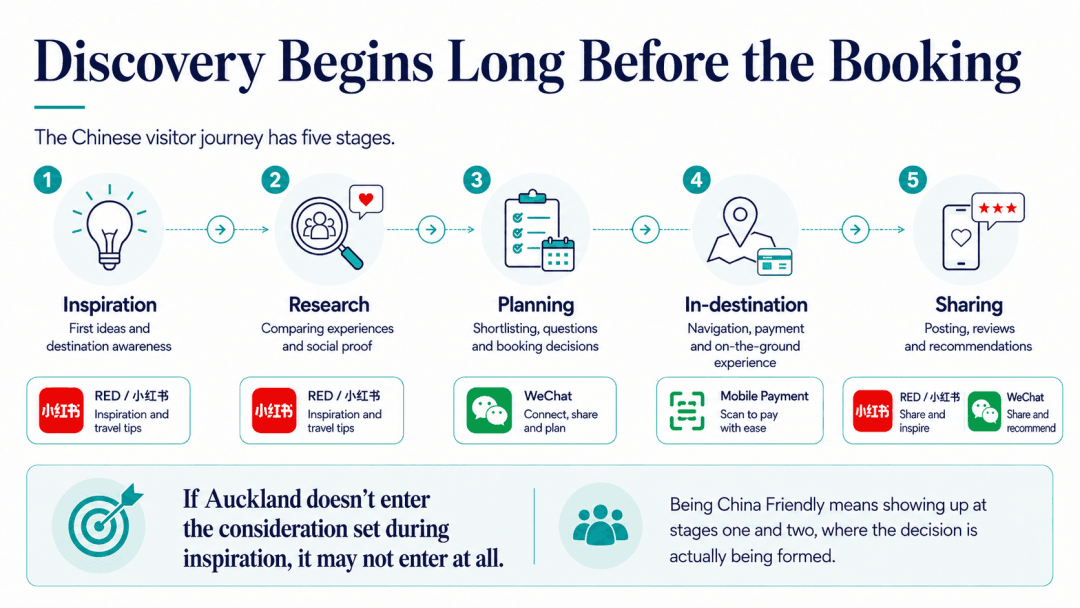
Discovery begins long before the booking
The Chinese traveller’s journey runs through five stages — inspiration, research, planning, in-destination, and sharing — and RED sits at the centre of nearly all of them. Auckland either enters a traveller’s consideration set during the inspiration stage, or it doesn’t enter at all. The problem is that most New Zealand operators only appear later, at the booking stage, and even then invisibly. Being China Friendly means showing up at stages one and two, where the decision is actually being formed.
An honest audit of where most operators stand
Assessed honestly, the common gaps cluster in a few places. On digital discovery: no RED presence, no Chinese-language content, no listing on China’s mapping platforms. On communication: no WeChat contact option and email response times measured in days rather than hours — for a Chinese enquiry, a 24-hour turnaround loses the booking. On payment: card and cash only, when Chinese visitors increasingly carry little foreign cash and expect WeChat Pay and Alipay. The advice we gave the room applies to any operator reading this: don’t try to fix everything at once. Pick your single highest-impact gap and start there.
The fixes cost time, not budget
The encouraging part is that becoming China Friendly rarely requires a marketing budget — it requires 30 minutes and the decision to begin. Create a WeChat business ID and add it to your website and email signature. Open a RED account and post a short Chinese description with a few strong photos. Sort out mobile payment. Brief front-of-house staff on a handful of Mandarin phrases — a simple “Nǐ hǎo” goes a long way. Prompt satisfied guests to share their visit on RED. None of these is expensive; all of them are visible to the traveller deciding whether to choose you.
Where to start
We’ve put the practical steps into a one-page China Friendly starter checklist — prioritised and free to implement. If you’d like a copy, or help setting up a RED account and your first few posts, get in touch. At UMS we help New Zealand and Australian businesses reach Chinese consumers through digital strategy, social media, influencer campaigns and bilingual content, with a team spanning Auckland and three cities in mainland China.