


Reflections from the NZCC report launch, March 2026
The numbers have always been striking. Chinese students represent 35% of New Zealand’s international enrolments, contribute roughly a third of our estimated NZ$3.3–3.6 billion export education revenue, and spend more per capita while here than almost any other student group. For institutions and agencies working in international education, China has long been the market that defines the sector.
But a new report launched this week by the New Zealand China Council challenges us to think beyond the numbers — and it’s a challenge worth sitting with.
The value that doesn’t show up on a balance sheet
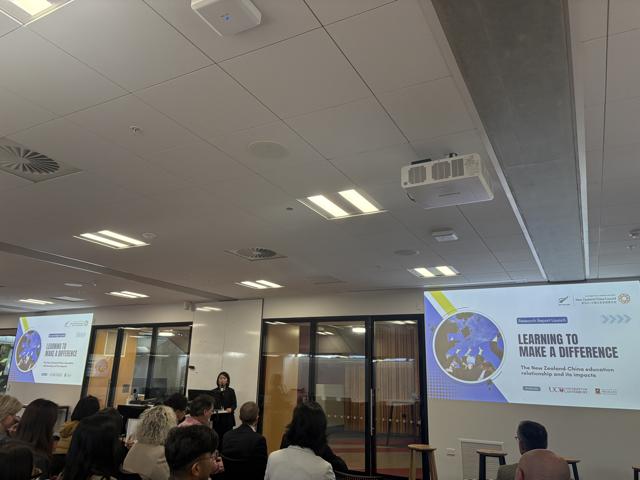
Learning to Make a Difference, authored by Rebecca Needham and released at the University of Canterbury, makes a compelling case that the real return on NZ–China education investment is measured in relationships, not just revenue. Chinese graduates who stay in New Zealand — or return home having studied here — often become the human connectors that drive bilateral trade, research collaboration, and cultural exchange for decades to come.
The report calls this “relationship infrastructure.” For those of us who work in education marketing and engagement, this framing should change how we think about what success looks like. A student who graduates, feels genuinely connected to New Zealand, and becomes an ambassador for this country in China is worth far more than a one-time enrolment.
The competitive reality
The report also delivers a clear wake-up call. The traditional ‘Big Four’ English-speaking study destinations — the US, UK, Canada, and Australia — have expanded into a ‘Big Fourteen’, with continental Europe and Asian destinations increasingly attractive to Chinese students and their families. As China’s birth rate declines, the pipeline of outbound students will eventually narrow, and the countries that have invested in their national education brand, institutional partnerships, and student experience will be best placed to compete.
At UMS, we see this dynamic every day in the work we do for education clients. Chinese students and their families research study destinations through platforms like RED (Xiaohongshu) and Douyin — not just Google. They’re influenced by peer reviews, alumni stories, and authentic institutional voices. The era of passive recruitment is well and truly over.
The two-way problem
Perhaps the report’s most sobering finding is the imbalance at the heart of the relationship. While China sends tens of thousands of students to New Zealand each year, the reverse flow is a trickle. Funding for Kiwi students to study in China has shrunk. Chinese language enrolments in New Zealand schools are declining.
NZCC Chair John McKinnon put it plainly: an education relationship that is too one-sided will not serve New Zealand well. China literacy — language skills, cultural understanding, genuine knowledge of our most important bilateral relationship — is a national capability issue, not just an education one.
What this means for education communicators and marketers
For those of us working to connect New Zealand institutions with Chinese audiences, the NZCC report reinforces a few things we believe deeply:
Authentic engagement beats transactional recruitment. Chinese families are sophisticated, digitally native, and highly attuned to whether an institution genuinely values them. Long-term brand building on Chinese platforms matters.
Post-study connection is an untapped opportunity. Supporting Chinese graduates after they complete their studies — helping them stay linked to New Zealand communities, institutions, and networks — is one of the most underleveraged strategies in the sector.
Two-way exchange needs a louder voice. Advocating for more New Zealanders to study in China, and for Chinese language learning in schools, isn’t just good policy — it’s good for the long-term health of the relationship that underpins our entire market position.
The NZCC report is available in full at nzchinacouncil.org.nz, alongside companion pieces on transnational education and recruitment channels. We’d encourage anyone working in the NZ–China education space to read it.
UMS has also recently released the China Report Card 2026, offering a timely view of the latest shifts in Chinese student demand, decision-making, and engagement trends — click here https://www.umssocial.com/china-report-card-education-update/2026 to download the full report.